| Test procedure |
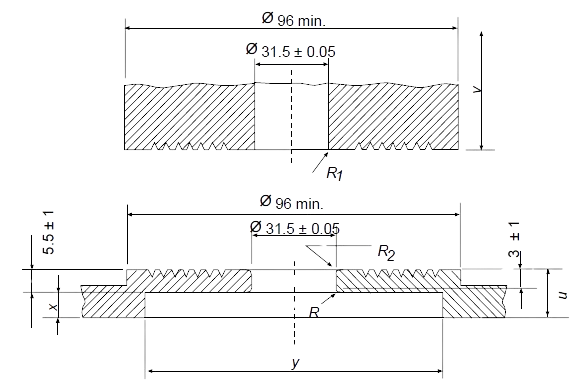
- Burst pressure is defined as the hydrostatic pressure in kPa required to produce rupture of the material when the pressure is increased at a controlled rate through a rubber diaphragm to a circular area of 31.5 mm diameter (see figure 1, 6.9). The area under the material is initially flat and held rigidly at the circumference but free to bulge during the test.
- Refer to Manufacturers Handbook or Standard Operation Procedure (SOP) for equipment calibration and operation procedures.
- Obtain a sample from a single lot of paper/board. From each test unit take 20 specimens. The test pieces shall be larger in area than the clamps of the burst tester and no area covered by the 2/3 clamp in one test shall be included in subsequent test areas - at least 62 x 62 mm sized.
- Samples shall not contain water marks, creases or visible damages.
- The test specimens should be condition as per standard WATER-GDC-T099.
- Test under these conditions.
- Clamp the test sample securely in the correct position in the sample holder (see figure 1, 6.9).
- Apply the hydrostatic pressure as specified until the specimen ruptures. The pumping rate shall
- be 100-170 ml/min. If slipping is indicated discard the test.
- Record the value.
- Repeat the above operation for the remaining samples and calculate the average value including
- The standard deviation.
- After each test run return the pressure indicator carefully to zero
- Make Ten tests on each side of the material
|
 Wissen BaumEngineering Solutions